
Table of Contents
Getting your first client feels harder than learning the actual skill.
That’s the part most beginners don’t expect.
You spend weeks watching YouTube tutorials, testing AI tools, designing logos, writing content, or building websites… then reality hits:
Nobody is paying you yet.
Here’s the truth most “make money online” videos won’t tell you:
Your first client usually comes from smart positioning — not talent alone.
And that’s where free AI marketing tools can help.
If you use them correctly, AI tools can help you:
- Find leads faster
- Create better outreach messages
- Build trust quickly
- Save time doing beginner tasks
- Look more professional even with little experience
But there’s a catch…
Most beginners use AI the wrong way. They spam cold messages, copy generic ChatGPT text, and wonder why nobody replies.
This guide will show you a realistic beginner strategy that works without paid ads, expensive software, or fake promises.
What Is “Finding Clients Using Free AI Marketing Tools”?
Simply put, it means using free AI-powered platforms to:
- Discover people who need help
- Create marketing content faster
- Improve communication
- Automate simple tasks
- Reach potential clients consistently
Instead of manually doing everything, AI acts like a productivity assistant.
For example:
- AI can help write cold emails
- AI can generate social media posts
- AI can improve your portfolio
- AI can research businesses
- AI can create proposals faster
The goal is not to “replace human effort.”
The goal is to remove beginner friction.
Pro Tip
Don’t hide behind AI.
Clients still hire humans they trust. AI should improve your execution — not become your personality.
Why Learning How to Find Your First Client Using Free AI Marketing Tools Matters
Most beginners quit too early because they wait for:
- Perfect skills
- A fancy website
- Certifications
- More confidence
Meanwhile, experienced freelancers know something important:
Action creates confidence faster than preparation.
Finding your first client matters because it gives you:
- Real-world experience
- Testimonials
- Portfolio material
- Confidence
- Referrals
- Proof that your skill has value
Ignoring this stage keeps you stuck in “learning mode” forever.
Here’s the Counter-Intuitive Insight
Your first client does NOT need perfection.
They usually need:
- Fast communication
- Reliability
- Simple results
- Someone who actually replies
That’s it.
A beginner who communicates well often beats a skilled freelancer who disappears for days.
Pro Tip
Small businesses care more about solving problems than fancy branding.
Focus on helping first.
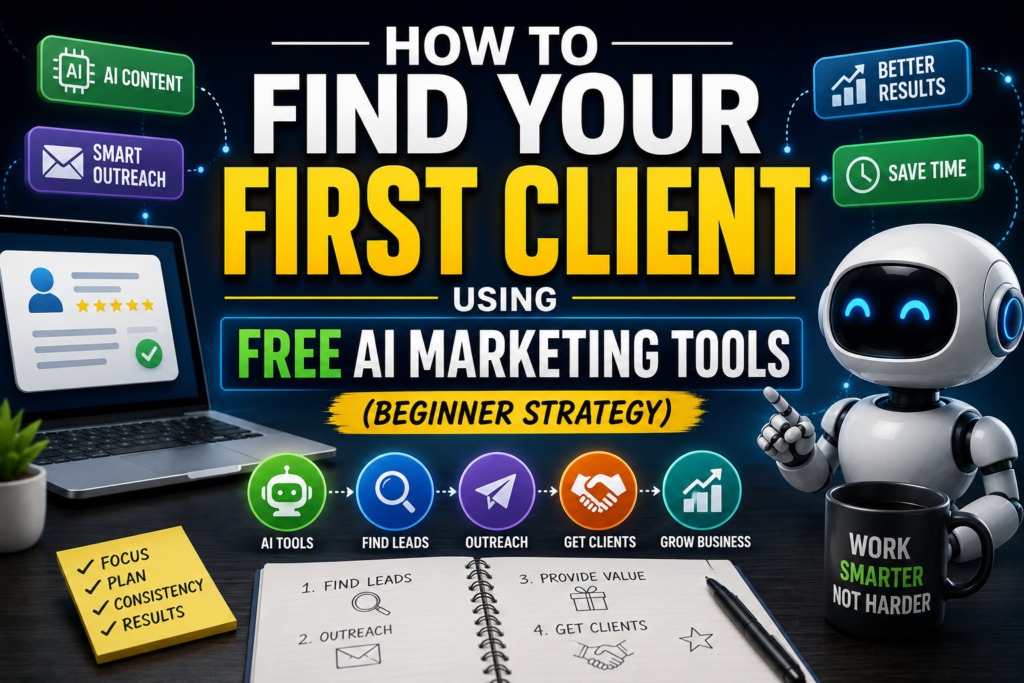
Step-by-Step Beginner Strategy to Find Your First Client
Step 1: Pick ONE Simple Service
This is where beginners mess up badly.
They say things like:
- “I do digital marketing”
- “I help businesses grow”
- “I’m an AI expert”
Too vague.
Instead, choose one beginner-friendly service:
- Social media post creation
- Blog writing
- Email copywriting
- Canva design
- SEO optimization
- Short-form video captions
- Facebook page management
Specific services are easier to sell.
Example
Bad:
“I help businesses online.”
Better:
“I create 5 engaging Instagram posts weekly for local businesses.”
See the difference?
Pro Tip
Start with services that produce visible results quickly.
Clients love fast wins.Step 2: Use Free AI Tools to Build Sample Work
You do NOT need paying clients before creating a portfolio.
This is a huge beginner misunderstanding.
Use free AI tools to create:
- Mock social media posts
- Sample blog articles
- Email campaigns
- SEO outlines
- Product descriptions
Create examples for imaginary businesses if necessary.
Lightbulb Moment
Clients care less about where the work came from and more about whether it looks useful.
Pro Tip
Make portfolio samples for local businesses in your area.
That makes outreach feel more personal later.
Step 3: Find Small Businesses That Already Need Help
This part is easier than people think.
Look for businesses with:
- Poor social media activity
- Weak websites
- No blog content
- Inconsistent branding
- Low engagement
Places to search:
- Facebook pages
- Google Maps
- Local business directories
Here’s the Catch…
Don’t target huge companies first.
Beginners waste time pitching brands that already have marketing teams.
Start small:
- Local restaurants
- Barber shops
- Coaches
- Small ecommerce stores
- Gyms
- Real estate agents
These businesses often need affordable help.
Pro Tip
Look for businesses posting blurry graphics or inactive social pages.
That’s usually a buying signal.
Step 4: Use AI to Personalize Outreach Messages
Most cold messages fail because they sound robotic.
Ironically, many people use AI to sound less human.
Bad outreach:
“Dear Sir/Madam, I noticed your business and would love to help increase revenue.”
Delete that immediately.
Instead:
- Mention something specific
- Keep it short
- Offer value first
- Sound natural
Example Outreach Message
“Hey James, I noticed your restaurant posts haven’t been active lately. I made 2 sample Instagram graphics you could use this week. Want me to send them over?”
Simple.
Human.
Helpful.
Pro Tip
Short messages outperform long sales pitches most of the time.
Especially for first-time freelancers.
Step 5: Offer a Small Starter Service
Beginners often try selling huge packages immediately.
That creates resistance.
Instead:
- Offer one small task
- Reduce risk
- Make saying “yes” easy
Examples:
- 3 social media posts
- One SEO blog article
- One email newsletter
- Basic profile optimization
This strategy works because businesses don’t feel trapped.
Counter-Intuitive Insight
Low-friction offers often convert better than “full marketing solutions.”
Especially when nobody knows you yet.
Pro Tip
Your first goal is not maximizing profit.
Your first goal is getting proof, testimonials, and experience.
Step 6: Follow Up Without Being Annoying
Most clients reply after follow-ups.
Not the first message.
But beginners either:
- Never follow up
- Or spam daily
Use a simple structure:
- Initial message
- Follow-up after 3 days
- Final check-in after 7 days
Keep follow-ups polite and short.
Example Follow-Up
“Hey James, just checking if you saw the sample posts I mentioned earlier.”
That’s enough.
Pro Tip
Persistence matters more than perfection in client acquisition.
Best Free AI Marketing Tools for Beginners
1. OpenAI’s ChatGPT
Great for:
- Writing outreach messages
- Blog drafts
- Content ideas
- Email copy
- Research summaries
Use it as an assistant — not a copy-paste machine.
2. Canva
Perfect for:
- Social media graphics
- Client presentations
- Portfolio samples
- Marketing visuals
The free version is enough for beginners.
3. Google Docs + Gemini
Useful for:
- Content planning
- Brainstorming
- Editing
- Collaboration
A solid free setup for freelancers.
4. HubSpot Free CRM
Helpful for:
- Tracking leads
- Organizing outreach
- Managing conversations
Most beginners ignore organization.
Big mistake.
5. Grammarly
Useful for:
- Fixing grammar
- Improving professionalism
- Making messages clearer
Poor communication kills trust fast.
Common Mistakes Beginners Must Avoid
1. Sending Generic AI Messages
People can smell copy-paste outreach immediately.
Personalization matters.
2. Waiting Until You Feel “Ready”
You’ll never feel fully ready.
Experience comes from action.
3. Offering Too Many Services
Focus wins.
General confusion leads to weak positioning.
4. Ignoring Follow-Ups
Many beginners lose clients simply because they disappear too quickly.
5. Depending Entirely on AI
AI cannot replace:
- Relationship building
- Trust
- Reliability
- Communication
Clients hire humans.
Remember that.
Pro Tip
Use AI for speed, not authenticity.
Your personality still matters.
Real-World Pro Tips From Experience
Build Relationships Before Selling
Comment on business posts first.
Engage naturally.
Warm outreach performs better than random cold pitching.
Create Before Asking
Want attention?
Send:
- A sample design
- A rewritten bio
- A content idea
- A mini audit
Value-first outreach changes the conversation.
Don’t Obsess Over Pricing Early On
Your first client is often worth more in experience than money.
That’s not glamorous advice, but it’s true.
Track Everything
Keep a spreadsheet with:
- Business name
- Contact date
- Follow-up date
- Response status
Consistency beats motivation.
The Biggest Lightbulb Moment
Finding clients is usually a volume game.
Not everyone will reply.
That’s normal.
If you contact:
- 10 businesses → maybe 1 reply
- 50 businesses → better odds
- 100 businesses → serious momentum
The beginners who win are usually the ones who stayed consistent long enough.
Conclusion: How to Find Your First Client Using Free AI Marketing Tools
Learning how to find your first client using free AI marketing tools is less about “hacking the algorithm” and more about becoming useful.
That’s the real strategy.
Use AI to:
- Save time
- Improve quality
- Stay organized
- Create faster
- Communicate better
But don’t make the mistake of hiding behind tools.
Clients want:
- Reliability
- Clear communication
- Consistency
- Simple solutions
Start small.
Send imperfect outreach.
Create sample work.
Follow up.
And most importantly — keep going longer than most beginners do.
That’s usually where the first client appears.
Internal Linking Ideas
- Beginner guide to AI content marketing
- How to create a freelance portfolio with AI tools
- Best free AI tools for online business beginners
External Authority References
- HubSpot
- Google Search Central
FAQs
1. Can beginners really find clients using free AI marketing tools?
Yes. Free AI tools help beginners create content, improve outreach, and save time. But success still depends on consistency and communication.
2. Which free AI tool is best for finding clients?
ChatGPT is one of the best starting tools because it helps with outreach, content creation, and idea generation.
3. How long does it take to get the first client?
It varies. Some beginners land a client within weeks, while others take longer. Consistent outreach usually matters more than speed.
4. Should I work for free to get experience?
You do not always need to work for free. Instead, consider offering a small low-cost starter service to build trust and testimonials.
5. What’s the biggest mistake beginners make?
Trying to sound overly professional and robotic. Simple, personal communication usually works better.